Iran is not on the brink of collapse. And it is no longer operating within its old margins of control.
These statements are true together. Beyond the scale of unrest, what distinguishes the current crisis from earlier protests is the compression of pressures across three domains that the Islamic Republic has historically managed separately: domestic legitimacy, economic survivability, and external deterrence.
For the first time in years, stress in all three arenas is unfolding simultaneously, leaving far less room for the regime to sequence repression at home while compartmentalising risk abroad.
What This Means
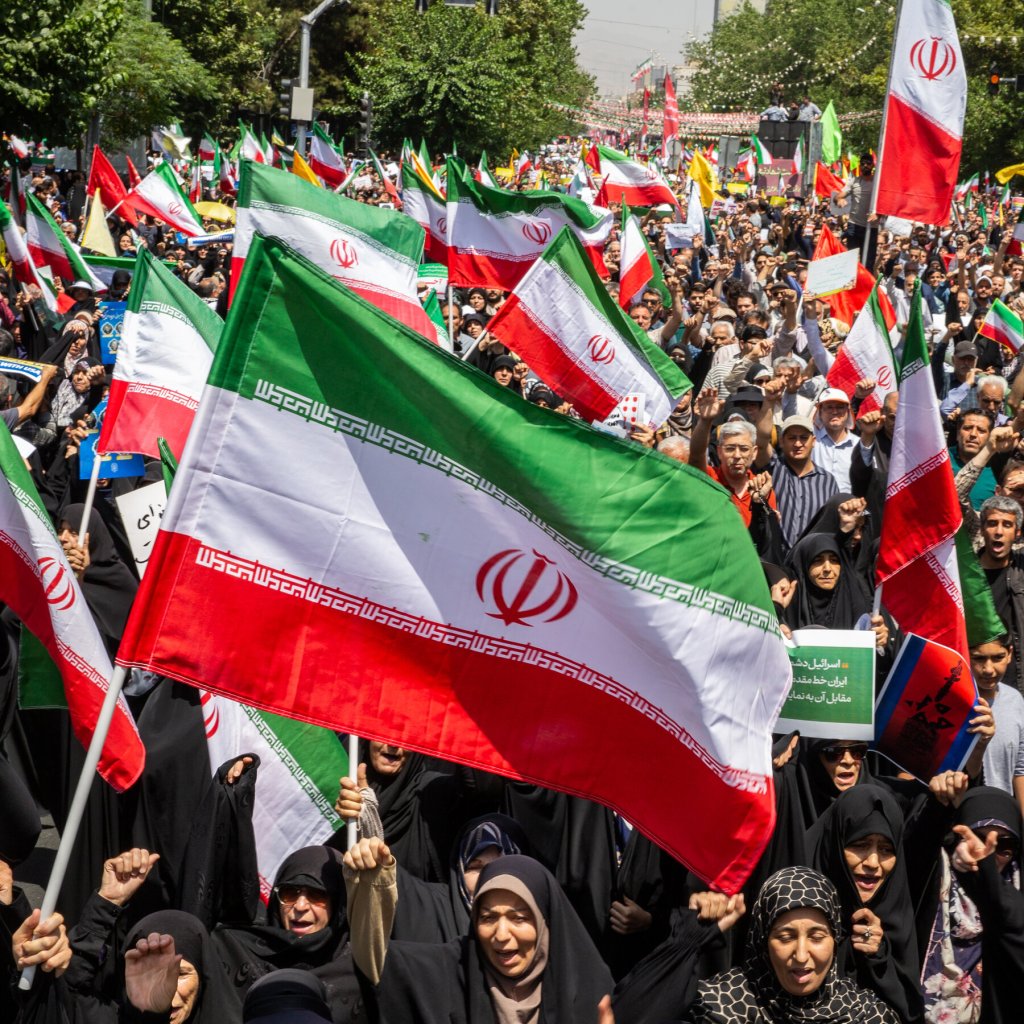
Since late December 2025, protests triggered by collapsing living standards and a sharp depreciation of the rial have metastasised into explicit challenges to the political order itself. The state’s response of lethal force, mass arrests, and near-total internet shutdowns has followed a familiar script.
Yet the context is materially different.
The Iranian economy is weaker, sanctions workarounds are thinner, and social compliance is historically low. Human rights monitors report thousands killed and tens of thousands detained, but the deeper signal lies in the regime’s growing reliance on coercion unbuffered by legitimacy or economic relief.
Externally, the pressure has shifted in form and intensity. The United States’ threat to impose 25% tariffs on countries trading with Iran represents a departure from traditional sanctions logic, effectively exporting Iran-risk into third-country trade relationships.
This move, coupled with unusually direct rhetorical encouragement of protesters from Washington, has reinforced Tehran’s long-standing belief that domestic unrest and foreign pressure are strategically linked. The Iranian state’s response of temporarily shutting its airspace and threatening capital punishment for demonstrators, and framing dissent as externally orchestrated reflects a regime that perceives escalation as a feature of its survival landscape.
As of this morning, tensions appear to have cooled marginally. President Trump has stated that Tehran has assured him executions will not take place and that killings have stopped, while Iranian officials have signalled that diplomacy remains preferable to war. These gestures, however, are tactical pauses aimed at preventing immediate spillover rather than resolving the underlying crisis.
Crucially, the Iranian regime does not currently resemble a state in freefall. The armed forces remain intact, elite cohesion has not visibly fractured, and the security apparatus continues to function. Yet history offers a sobering lesson: autocracies rarely collapse gradually. When they fall, it is often rapidly and unexpectedly, once a threshold is crossed within the coercive core or the elite bargain that sustains it.
It is against this backdrop that the question confronting policymakers is not whether Iran will change, but what kind of change is conceivable, and what each pathway would mean for the world. Iran occupies a uniquely sensitive position at the intersection of regional power balances, nuclear proliferation risk, global energy markets, and great-power competition. Any transition, whether controlled, coerced, or chaotic, would therefore produce consequences that are profound but uneven, shaped less by the language of revolution and more by the institutional mechanics of power during moments of stress.
The Contours of Domestic Upheaval
What has actually broken inside the Iranian system?
The leadership has faced protests before; what is new is how little time elapsed between price shock and political rupture. In past crises, the state contained dissent through a mix of subsidies, selective repression, and regional isolation. This time, none held. Citizens across all socio-economic classes in all 31 provinces moved simultaneously.
The triggers are familiar: inflation, currency collapse, unaffordable food. What is new is the speed. Economic anger turned political almost immediately, bypassing demands for relief and moving straight to regime-directed slogans, even calls for overthrow. This echoes the early Arab Spring, when governments mistook economic protest for a solvable fiscal problem and discovered that legitimacy had already collapsed.
Equally important is what this uprising lacks.
Unlike the “Women, Life, Freedom” protests of 2022, there is no moral anchor or identifiable cause that can be selectively co-opted, reframed, or partially conceded. Nor is there a single figurehead capable of being neutralised or negotiated with. External personalities, including the exiled Crown Prince Reza Pahlavi, have attempted to position themselves as symbols of a post-Islamic Republic future, but this effort has exposed a deeper reality:
Iran’s opposition is not leaderless because of repression alone; it is fragmented because there is no shared vision of the state that should replace the current one. Monarchists, secular republicans, reformists, labour movements, and ethnic minorities are united in rejection, not in construction.
The most analytically important feature of the current upheaval is therefore not its scale, but its character. This is not an ideological or generational rebellion. It is a revolt against governability itself. Across class, region, and identity, Iranians are confronting a state that is no longer perceived as capable of delivering either material stability or political meaning.
When citizens stop asking what the state should do and start questioning why it should exist in its current form, repression can still work but only at rising costs and diminishing returns.
That is the inflection point Iran is approaching.
Regime Change Is Neither Simple Nor Straightforward
When international observers speak of “regime change” in Iran, they often compress fundamentally different political trajectories into a single phrase. This is simplistic.
In practice, regime change covers very different outcomes, each with sharply different consequences at home and abroad. These range from the regime crushing dissent and staying in power, to limited reform or elite-led transition, to state collapse and fragmentation, or even the rise of a foreign-backed figure claiming authority from outside Iran.
Each pathway implies a different balance between stability, violence, legitimacy, and external risk. The global consequences of Iran’s turmoil therefore depend less on the abstract idea of “change” and more on which of these pathways, if any, materialises.
The Coercive Core: Why Iran’s Security Apparatus Determines the Fate of Any Transition
At the centre of all plausible scenarios sits Iran’s coercive apparatus, above all the Islamic Revolutionary Guard Corps (IRGC) and its affiliated institutions, including the Basij, the intelligence services, and specialised police units. These forces are integral to how the Islamic Republic functions. Since the early years after 1979, the IRGC has evolved from a revolutionary guard into a parallel state structure, controlling significant segments of Iran’s economy, exerting influence across politics and media, and anchoring Iran’s regional military strategy. This embeddedness means that the question of transition is inseparable from the question of what the security forces do, and on whose behalf.
Formally, Iran’s security forces are subordinate to the Supreme Leader, Ali Khamenei, not to the elected government of President Masoud Pezeshkian. The IRGC answers directly to the office of the Supreme Leader, bypassing civilian ministries and parliamentary oversight. This structure was designed precisely to insulate the core of the regime from electoral volatility and public pressure. Over time, it has also produced a security elite whose institutional interests are tied to regime survival: access to economic rents, protection from legal accountability, and continued ideological and strategic relevance. As a result, the security forces are not neutral arbiters in moments of crisis unlike their neighbours who halted support for Presidents and leaders during the Arab Spring. IRGC is a political actor with a stake in the outcome.
The Basij militia plays a distinct but complementary role. Drawn from local communities and embedded in neighbourhoods, universities, and workplaces, it functions as both an intelligence-gathering mechanism and a tool of social control. Unlike professional military units, the Basij’s strength lies in its proximity to ordinary citizens. This closeness allows the state to monitor dissent early and to fragment protest movements by inserting fear, informants, and selective punishment into everyday life. It also creates a deeply corrosive relationship between state and society, in which mistrust replaces consent and political participation is mediated by coercion rather than legitimacy.
The relationship between citizens and the security forces is therefore not simply one of repression versus resistance; it is one of prolonged estrangement. For many Iranians, particularly younger generations, the IRGC and Basij are no longer seen as national protectors but as instruments of exclusion, economic privilege, and violence. At the same time, the security forces do not operate in a vacuum. They recruit from Iranian society, draw on familial and regional networks, and are acutely aware that excessive fragmentation or civil war would threaten their own institutional survival. This tension between coercive dominance and social alienation defines the regime’s current stability.
Due to this structure, Iran’s transition likelihood hinges on how the security apparatus responds to sustained pressure. If the IRGC and allied forces remain unified and loyal to the Supreme Leader, repression can continue even in the face of deep popular opposition, producing a hardened but intact state. If elements of the security elite decide that repression is no longer sustainable, they may bargain for a controlled transition that preserves their core interests while conceding limited political change. If, however, the coercive institutions fracture, whether along ideological, generational, or material lines, the risk of rapid escalation and fragmentation increases sharply.
This is why regime change in Iran cannot be understood as a simple switch from one leadership to another, or from authoritarianism to democracy. It is an institutional problem before it is a political one. Any transition that does not account for who controls coercion, how that control is exercised, and how the security forces perceive their own future is unlikely to be stable. Conversely, any scenario in which those institutions are brought into a negotiated settlement, however imperfect, has a far greater chance of limiting violence and preventing collapse.
The Myth And Reality Of A Pahlavi Restoration
Among opposition figures, Reza Pahlavi is the most internationally recognisable symbol of anti-regime sentiment. He has consistently called for peaceful protest and a referendum on Iran’s future political system, positioning himself as a convenor rather than a would-be monarch. This visibility, however, has generated a misleading narrative of a plausible “return and rule” pathway.
Several constraints are decisive. Iran’s opposition is ideologically heterogeneous: monarchists, secular republicans, reformists, labour movements, and ethnic nationalists do not share a unified vision of the post-Islamic Republic state. Monarchist nostalgia resonates with some urban and diaspora constituencies but remains deeply contested, particularly among groups that associate the pre-1979 order with repression and exclusion. Most critically, domestic organisational capacity matters. No figure abroad, however symbolically powerful, can substitute for cohesive internal leadership in the face of a highly integrated security apparatus.
Pahlavi’s potential role, therefore, is limited and conditional. He may serve as a symbolic rallying point in international discourse or as one voice in a broader transitional coalition. But the decisive dynamics of any stable transition will be shaped inside Iran, by internal alliances, institutional fractures, and control over coercive power, not by restoration narratives.
Conclusion
The protests are not yet revolutionary in outcome, but they are revolutionary in implication. They reveal a society that has withdrawn consent without yet agreeing on an alternative, and a regime that can still coerce, but no longer persuade. That combination is far more destabilising than either mass mobilisation or elite dissent alone, and it is why Iran’s crisis should be read not as another protest cycle, but as a structural stress test of the Islamic Republic itself.

 Inflect
Leave a comment