ASHA workers are central to India’s last-mile health delivery, now performing far beyond the limited, part-time mandate originally assigned to them. Yet they remain classified as voluntary workers, compensated largely through fragmented incentives. This gap between expanding responsibilities and static institutional design exemplifies institutional drift, producing income insecurity, administrative inefficiencies, and long-term risks to service continuity. Situated within a shared Union–state financing framework, any reform must navigate fiscal constraints across governments. The article proposes calibrated, phased reforms- stabilising compensation, strengthening social protection, and enabling career progression- to align the programme’s structure with its operational reality while preserving fiscal balance.
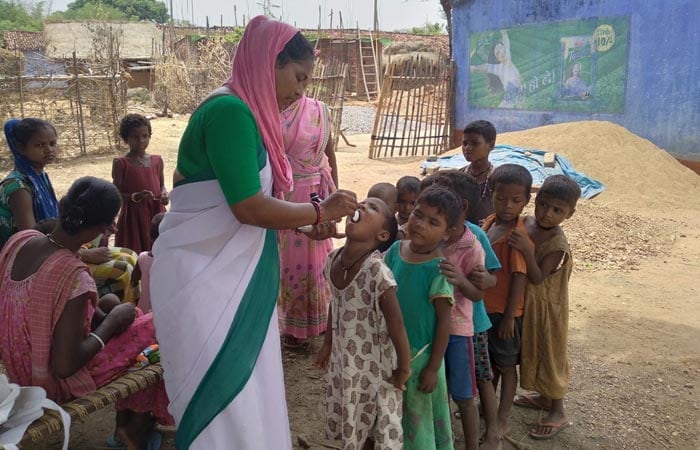
Image source: NDTV
In the narrow lanes of India’s villages and the crowded settlements at its urban edges, the first knock on a door during pregnancy, illness, or vaccination season is often not from a doctor or nurse, but from an ASHA worker. She is a neighbour, guide, data collector, counsellor, and sometimes the only visible face of the public health system. For millions of households, the state arrives in the form of a woman carrying a register and a mobile phone.
Yet the institutional design that governs her work has not kept pace with her role. Conceived as a voluntary community mobiliser, the ASHA worker has gradually become a full-time frontline provider on whom the health system depends for service delivery, data collection, and programme implementation. This quiet shift from volunteer to de facto worker- without a corresponding change in pay structures, employment status, or administrative norms- illustrates a classic case of institutional drift. The consequences are not only ethical but fiscal and administrative. A workforce that performs core state functions is funded through fragmented incentives, irregular payments, and off-budget arrangements, creating inefficiencies, accountability gaps, and chronic uncertainty for both workers and the health system itself.
Programme Expansion and Design Misalignment
India’s Accredited Social Health Activist (ASHA) programme was introduced in 2005 under the National Rural Health Mission as a community-based, incentive-driven model intended to improve maternal and child health outcomes. The original design envisioned one ASHA per 1,000 people, performing a limited set of outreach functions such as pregnancy registration, institutional delivery promotion, immunisation mobilisation, and basic health counselling.
Over two decades, the programme has scaled into the largest community health workforce in the world, with approximately 1.05 million ASHA workers across India.
Their responsibilities expanded from a narrow maternal-child health focus to a wide spectrum of tasks: tuberculosis treatment adherence, non-communicable disease screening, household surveys, digital data entry, and pandemic response. National Health Systems Resource Centre assessments indicate involvement in more than 15–20 programme-linked activities by 2021.
This expansion occurred alongside a broader transformation in India’s public health indicators. The maternal mortality ratio declined from 254 per 100,000 live births in 2004–06 to 88 in 2018–20, a reduction of over 65 percent. Full immunisation coverage increased from 43.5 percent in 2005–06 to 76.4 percent in 2019–21. Evaluations of India’s community health system consistently attribute part of these gains to ASHA-led last-mile mobilisation.
However, the programme’s employment design has not evolved at the same pace. ASHAs remain officially classified as “voluntary honorary workers” under National Health Mission guidelines. This divergence between functional dependence and employment status represents a classic case of institutional drift, in which the operational scope of a programme outgrows its original design.
Workload Expansion Within a Part-Time Compensation Model
The original ASHA guidelines envisaged a limited set of maternal and child health tasks carried out on a part-time basis. Subsequent programme expansions, however, have steadily increased both the number and complexity of responsibilities.
Time-use studies show that ASHAs now work significantly more than originally intended. A multi-state assessment found that ASHAs spent 6+ hours per day on programme activities, with additional time required for travel and record-keeping. Another study across six states reported that up to 40 percent of ASHA work time was spent on documentation and reporting, particularly after the introduction of digital health systems. Population coverage has also expanded in several states. While the official norm remains one ASHA per 1,000 population, district-level studies in high-density regions found effective coverage ratios of 1,500–2,000 people per ASHA, particularly in peri-urban areas.
Despite this expansion, the compensation structure continues to reflect the programme’s original part-time design. The central government currently provides a fixed monthly honorarium of ₹2,000 per ASHA, supplemented by performance-based incentives, while state top-ups vary widely. Survey evidence suggests that total monthly earnings typically range between ₹4,000 and ₹8,000, placing many ASHAs below statutory rural minimum wage levels in several states. Payment delays are also common, with cross-state studies finding that more than half of ASHAs experience delays of over two months in receiving incentives.
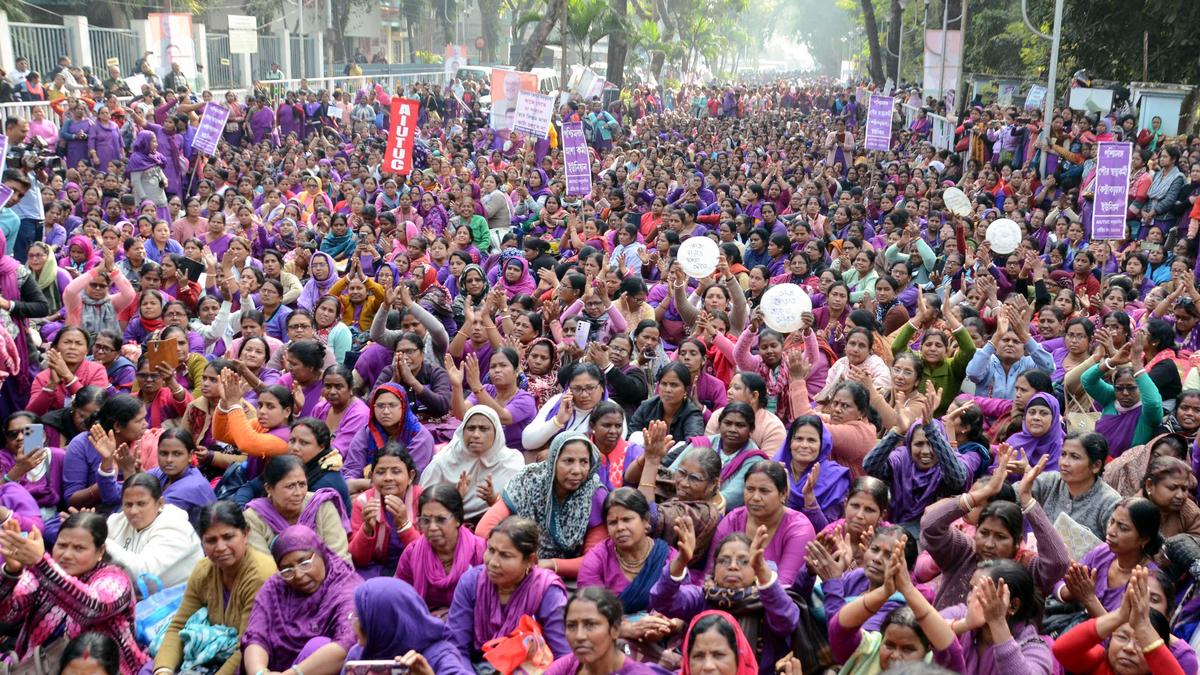
Image source: The Hindu
For a workforce drawn largely from low-income households, irregular and uncertain earnings directly affect work intensity. When payments are delayed or insufficient, ASHAs often prioritise alternative income sources, reducing time for field outreach. This creates a structural contradiction: as responsibilities expand and become more technical, the compensation system remains tied to fragmented, task-based incentives designed for a smaller, part-time role.
The consequences are gradual but significant. Evidence across community health worker programmes links low or irregular remuneration to reduced motivation and higher attrition. In India, dissatisfaction with incentives and payment delays is a leading cause of turnover. Recruitment and retention may become more difficult, especially in urban or high-cost regions, while administrative overload risks eroding the community presence that underpins the model. Periodic protests and work stoppages, already visible in several states, highlight the system’s dependence on a workforce without formal employment protections. What appears as a short-term fiscal saving may thus translate into long-term operational instability in programmes that rely on consistent, last-mile engagement.
The Fiscal and Federal Logic of the Volunteer Model
The future of ASHA reform will be determined less by the moral strength of worker demands and more by the interaction between fiscal constraints, administrative flexibility, and the federal structure of India’s health financing. The ASHA programme sits within the National Health Mission, a centrally sponsored scheme that depends on shared funding and administrative cooperation between the Union and the states. This institutional location shapes the boundaries of reform. Any move toward full regularisation would not be a single policy decision, but a coordinated fiscal and administrative shift across multiple governments, each operating under different budgetary and political constraints.
For the Union government, the scheme-based structure provides important advantages. It allows rapid expansion of programmes without locking in long-term pension and salary liabilities. It also enables functional flexibility: new tasks can be added, incentive structures can be revised, and programme priorities can shift without renegotiating service rules or cadre structures. This flexibility has been central to the expansion of ASHA responsibilities over time, from maternal health to non-communicable diseases, digital surveys, and pandemic response. A fully regularised workforce would make such shifts slower and more legally complex, as employment protections and unionisation would introduce additional procedural constraints.
For state governments, the fiscal logic is even more immediate. Salaries, pensions, and social security obligations are recurring expenditures that directly affect state budgets. Many states already spend a large share of their revenue on salaries and interest payments. Regularising over one million ASHA workers would not only increase immediate wage expenditures but also create long-term pension liabilities. More importantly, it would establish a precedent. India has over 1.4 million Anganwadi workers and helpers under the ICDS scheme, as well as large numbers of mid-day meal workers. Regularising one major scheme-based workforce could trigger similar demands across others, increasing state wage liabilities significantly.
This combination of central flexibility and state fiscal caution has produced a stable equilibrium. The system relies heavily on ASHAs for last-mile service delivery, but both tiers of government retain incentives to preserve the scheme-based model. As a result, policy responses to ASHA protests have generally taken the form of incremental adjustments rather than structural redesign. States have periodically raised honoraria, introduced insurance schemes, or provided retirement grants, but without altering the underlying classification of ASHAs as voluntary or scheme-based workers. These measures address immediate political pressure while preserving long-term fiscal and administrative flexibility.
Incremental Models for Strengthening the System
Debates around the future of the ASHA workforce are often framed as a binary choice between full regularisation and the continuation of the volunteer, incentive-based model. In practice, most countries confronting similar dilemmas have avoided such stark transitions. Instead, they have pursued gradual, hybrid pathways that improve income stability, social protection, and career prospects, while allowing governments to phase in fiscal commitments and retain administrative flexibility. These approaches have proven more politically feasible and institutionally durable.
One common pathway is the gradual absorption of experienced workers into fixed public health cadres. Brazil’s community health agent programme followed this trajectory. Initially introduced as a stipend-based outreach initiative, it became central to the country’s Family Health Strategy. As reliance on these workers increased, municipalities began absorbing them as formal employees with fixed salaries and labour protections, with fiscally stronger regions moving first. India’s own Auxiliary Nurse Midwife (ANM) cadre reflects a similar historical evolution, where community-based roles were progressively formalised as the health system expanded. These experiences suggest that formalisation can be phased and selective, prioritising long-serving or high-performing ASHAs, so that workforce stability improves without imposing immediate, system-wide fiscal commitments.
Elsewhere, the emphasis has been on creating structured career ladders and bridge programmes. Ensuring mobility through training and certification allows community health work to serve as an entry point rather than a terminal role. Ethiopia’s health extension system illustrates this approach. Salaried Health Extension Workers deliver frontline services, supported by volunteer community mobilisers, while experienced workers are offered training pathways into more specialised positions. This layered structure combines volunteer outreach, salaried service delivery, and professional advancement. Applied to India, such a model would allow ASHA experience to translate into progression toward roles such as ANMs or community nurses, addressing shortages in formal cadres while improving motivation and retention.
In other contexts, governments focus on expanding social security and predictable compensation without altering formal employment status. This approach addresses the most immediate sources of worker precarity: income instability, health risks, and lack of retirement support, while retaining the scheme-based structure. Thailand’s village health volunteer system evolved along these lines, with increased allowances, training-linked incentives, and social protection measures such as insurance. Although volunteers were not fully regularised as civil servants, the system gradually developed predictable payments and clearer roles within primary care teams. This kind of hybrid arrangement offers a more immediate reform option for India: establishing a national floor for compensation, ensuring timely payments, and extending basic insurance and pension coverage, even while the broader question of employment status remains under debate.
Taken together, these experiences point toward a more pragmatic reform sequence than the current binary debate suggests. Rather than choosing between universal regularisation and the status quo, India could adopt a tiered approach: stabilising incomes and social protection in the short term, creating career ladders into formal cadres in the medium term, and gradually absorbing long-serving workers into regularised positions. Such a pathway would recognise the programme’s evolution, improve retention and performance, and distribute fiscal commitments over time, aligning the institutional design of the ASHA programme more closely with the role it now plays in India’s health system.And so we return to the word asha-hope. The programme stands today as one of the government’s most significant public health achievements, built through sustained investment and federal cooperation. However, it now sits at a turning point. As the system evolves, the next phase will be about careful alignment. The question ahead is less about labels and more about alignment: ensuring that the structure of the programme reflects the realities of the work it performs. Incremental reforms that strengthen income stability, social protection, and career pathways can build on existing gains while preserving fiscal balance and administrative flexibility. In doing so, the programme can continue to deliver on its original promise- bringing reliable, community-based healthcare to every doorstep.

 Inflect
Leave a comment