India recently announced a ₹1 Lakh Crore R&D fund. While this could potentially be transformative, sustained progress in strategic and frontier technologies is not only a function of releasing funding or establishing missions. Frontier technology competitiveness depends on achieving mission delivery timelines, retaining innovation spillovers, and building sustained technical capacity. Without researchers to execute these missions, increased R&D spending cannot translate into technology readiness or innovation outcomes. India presently lacks an anchored, end-to-end national strategy to retain domestic talent and attract globally competitive researchers. This piece examines why existing efforts remain fragmented and outlines a “National Talent Strategy” focused on institutional ownership, career pathways, and enabling conditions, sequenced for realistic implementation.

Image source: The Hindu
Over the past few years, public investment in R&D has expanded through mission-mode programmes in AI, quantum, semiconductors, biotech, space, and clean energy. This includes the establishment of the Anusandhan National Research Foundation (ANRF) and the Research, Development and Innovation (RDI) scheme, which promises ₹1 Lakh Crore to strengthen India’s R&D ecosystem. The Union Budget 2026–27 reinforces this push. It introduces the India Semiconductor Mission 2.0 (ISM 2.0), Biopharma SHAKTI, and incentives for cloud, data centres, and rare earth manufacturing. These initiatives emphasise increased funding availability and a growing focus on translational research, private sector participation, and higher technology readiness levels.
Yet, despite expanded missions and funding, India remains weak in attracting frontier scientific talent. This includes PhDs, post-doctorates, and advanced technical specialists across academia, industry, and mission programmes. India ranks 100/135 in the Global Talent Competitive Index 2025 and scores poorly on the ‘attract’ sub-pillar, reflecting low global openness. In the IMD World Talent Ranking 2025, India ranked 63rd out of 69 economies, falling from its 58th position in 2024. In the “appeal” sub-category (the extent to which a country taps into the overseas talent pool), India ranks 61st.
Retention outcomes are similarly weak. As per a 2025 study, 28% of Indian researchers experience international mobility, and over 73% do not return. Exits are concentrated among graduates of premier institutions. The problem is therefore not the absence of programmes or funding. It is the absence of a coherent talent system.
Mission timelines require specialised talent. The ‘India Semiconductor Mission’ targets fab capacity by 2027. Quantum computing initiatives aim for proof-of-concept systems within five years. These timelines depend on researchers who can move from concept to application. When 73% of internationally mobile researchers do not return, mission delivery becomes constrained by human capital, not funding.
Innovation spillovers depend on retention. Researchers who stay build labs, mentor students, file patents, and create commercial spinoffs. When they leave, India funds their training, but other countries capture the returns. China is increasingly producing and retaining a high percentage of their PhD graduates, enabling cumulative knowledge building. India loses this compounding effect. The result is that R&D investments produce research papers, but technology leadership remains elsewhere.
Why the Current System Does Not Work
As India’s research ecosystem expanded projects, platforms, and financing, the ownership of talent outcomes remained fragmented across ministries, missions, and government agencies. No institution is mandated to manage end-to-end talent outcomes spanning attraction, retention, mobility, and career progression across academia, industry, and government.
Consider ANRF, India’s flagship research funding mechanism. It is designed to steer research funding and priorities, not immigration, career pathways, or long-term talent retention. These functions fall outside its mandate and institutional design. Immigration sits with the Ministry of Home Affairs (MHA) and the Ministry of External Affairs (MEA). Career pathways depend on universities and the University Grants Commission. Retention incentives require coordination across the Ministry of Finance, the Ministry of Science and Technology (MoST), and individual institutions. No single actor is responsible for the full talent lifecycle.
There have been some successful targeted return mechanisms. Between 2020 and 2025, approximately 550 researchers returned under the “Ramanujan Fellowship”, while nearly 627 candidates availed the DBT “Ramalingaswami Re-entry Fellowship” since its inception in 2007 till 2025. However, these schemes focus narrowly on diaspora returnees and operate as standalone instruments, often without predictable absorption into long-term roles or institutional incentives for retention. This fragmentation persists because talent outcomes cut across funding, education, immigration, labour, and urban governance, none of which are institutionally incentivised to prioritise scientific workforce outcomes. This, in turn, produces four structural weaknesses:
- Fragmented ownership across ministries and agencies
- Over-concentration on diaspora returnees
- Unclear career pathways due to institutional rigidity
- High ecosystem friction, including visas, mobility, and quality of life
Designing a National Talent Strategy
Addressing these weaknesses requires coordinated interventions. A National Talent Strategy should be anchored in clear institutional ownership and operationalised through career pathways, targeted incentives, and enabling mobility frameworks. Institutional ownership and career pathways must precede large-scale incentives because, without this sequencing, incentives have limited retention impact.
1) Establish Clear Institutional Ownership
This talent mission could be housed within the MoST as a horizontal programme with clear outcome ownership. A similar anchoring logic is visible in sectoral missions where digital and AI initiatives are coordinated through the Ministry of Electronics and Information Technology, but cut across different verticals and sectors.
This does not require a new agency. Instead, MoST would serve as the nodal ministry responsible for talent outcomes, with the Prime Minister’s Office providing oversight and NITI Aayog offering coordination and analytics support. MoST would track benchmarks on attraction, retention, and progression through a Monitoring, Evaluation and Learning (MEL) framework. Institutions and programmes would provide structured feedback to ensure this remains an iterative process. MoST would only coordinate and track outcomes, not run individual schemes. This is the highest priority intervention because other levers cannot scale without aligned ownership.
2) Design Talent-Centric Career Pathways
Career pathways must operate as long-term progression tracks rather than isolated fellowships. Career progression is the central determinant of long-term retention.
Early career pathways should enable mission-linked fellowships with guaranteed research infrastructure access. Attrition peaks in mid-career, when researchers face uncertainty about progression, infrastructure access, industry transitions, and mobility options. Mid-career pathways should therefore include joint academia-industry appointments and translational funding.
Interoperability between academia, public research institutions, and industry should enable lateral mobility through these joint appointments without career penalties. Industry must also be positioned as a core career destination with co-owned pathways and shared funding responsibility. Senior career pathways should include leadership tracks and chairs linked to national programmes. These instruments already exist but function as standalone schemes rather than progressive pathways.
Execution requires coordination across multiple actors. The Ministry of Science and Technology would set pathway frameworks and benchmarks. Premier institutions like the IITs, IISc, and IISERs would pilot structured progressions from fellowship to tenure. The Ministry of Education and UGC would need to enable regulatory flexibility for joint appointments. Industry would co-fund mid-career positions and provide translational research opportunities.
3) Create an Enabling Incentive Framework
Financial incentives should be globally benchmarked but selectively deployed in premier institutions, mission-linked roles, and leadership positions where more leverage exists. Non-financial frictions increasingly shape decisions, especially for mid and senior career researchers. Priority reforms include visa facilitation, easing Overseas Citizenship of India (OCI) processes, and spousal employment coordination with MEA and MHA. Broader quality of life constraints, such as congestion and air quality, require longer-term cross-government coordination and development of well-serviced innovation corridors.
In the short term, implementation would require coordination led by the Ministry of Science and Technology, in consultation with the Ministry of Finance for incentive structures and with the Ministry of Home Affairs and the Ministry of External Affairs for mobility and visa reforms.
Policy Levers: Implementation Challenges and Solutions
Moving from strategy to implementation requires anticipating resistance. Each recommendation described in the previous section addresses a specific bottleneck but faces distinct implementation barriers. Table 1 maps why each matters, likely resistance, and practical pathways to implementation.
| Lever | Significance | Expected Pushback | Mitigation |
|---|---|---|---|
| Institutional Ownership | Aligns fragmented programmes into one talent system. Without this, other reforms don’t scale. | Ministries and agencies could fear loss of control over programmes or missions. | Keep programme autonomy intact. MoST tracks outcomes and coordinates, not runs schemes. |
| Career Pathways | Retention depends on predictable progression, especially mid-career. | Rigid university and government rules; faculty resistance. | Start with pilots in select premier institutions and missions, then expand gradually after certain pre-defined metrics are met and outcomes are visible. |
| Financial Incentives | Global talent compares opportunity costs across countries. | Fiscal concerns and equity backlash over differentiated pay. | Limit to mission and leadership-linked roles with transparent criteria and industry co-funding. |
| Mobility and Visa Facilitation | Administrative friction often outweighs salary differences. | Security and reciprocity concerns. | Apply only to defined institutions, roles, and fixed-term research positions. |
| Quality of Life Improvements | Long-term retention depends on living conditions. | Requires sustained coordination with states and urban bodies. | Begin with a few research clusters and innovation corridors. |
Table 1: Policy Levers: Rationale, Resistance and Mitigation
Who Will Fund This?
Implementing this strategy requires coordinated funding across government, industry, and philanthropic sources. Institutional anchoring and monitoring would be funded through existing MoST and Department of Science and Technology (DST) budgets. Career pathway pilots would draw from the ₹1 Lakh Crore RDI Fund and ANRF grants. Financial incentives for mission-linked roles would use blended funding, with the government providing base compensation, industry co-funding competitive premiums for joint appointments, and philanthropic sources supporting select fellowship programs. This architecture distributes fiscal responsibility while ensuring no single funding source becomes a bottleneck.
Sequencing and Prioritisation
Understanding these challenges clarifies why sequencing matters. Mitigation strategies succeed only when implemented in the right order. Deploying financial incentives before establishing career pathways, for instance, would yield limited retention impact.
The matrix below (Figure 1) maps interventions along two dimensions: execution complexity (feasibility) and time horizon. It also highlights structural vs. enabling levers (impact depth). This suggests a phased approach:
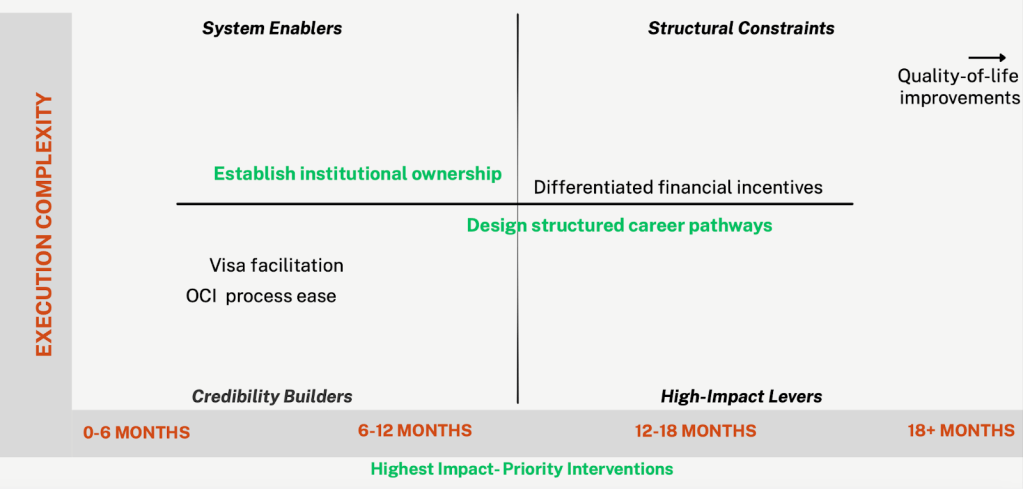
Figure 1: Impact, Feasibility, and Time-Horizon Mapping of Talent Policy Levers
1) Institutional ownership is the prerequisite system enabler.
2) Structured career pathways are high-impact retention levers.
3) Differentiated financial incentives support attraction but face fiscal and political constraints.
4) Visa and mobility facilitation act as credibility builders and can be implemented in the short term.
5) Quality of life improvements remain long-term structural constraints.
Indicative sequencing follows a phased approach. In the first 0 to 6 months, visa facilitation and OCI process easing can begin alongside institutional anchoring. Between 6 and 12 months, structured career pathways can be operationalised. Between 12 and 18 months, differentiated financial incentives can be piloted in mission-linked and leadership roles. Beyond 18 months, quality of life improvements and innovation corridors operate as longer-term enabling conditions.
Conclusion
India’s push into frontier technologies has created strong missions, funding, and institutions, but not a coherent system for scientific talent. Progress has been limited by fragmented mandates, ambiguous career pathways, and rigid compensation structures that discourage long-term careers in India. Without researchers to execute missions, increased funding cannot deliver technology readiness or translational outcomes.
A National Talent Strategy anchored in institutional accountability and focused on careers, incentives, and mobility can convert India’s scientific capacity into sustained innovation outcomes aligned with Viksit Bharat 2047. This matters for emerging tech governance equally. AI, quantum, and semiconductors carry geopolitical implications. Without a coherent talent system, mission delivery slows and strategic leverage weakens. If India cannot retain researchers in these fields, the country is not just losing economic opportunity. It is ceding strategic autonomy as well.


 Inflect
Leave a comment