India’s higher education system has expanded rapidly, yet labour market outcomes reveal a widening gap between degrees and employability. As automation and digitalisation reshape workforce demand, the challenge is no longer access to education but alignment with economic realities. Drawing on labour market data and reforms under NEP 2020, this article examines the structural drivers of skill mismatch, including rigid curricula, limited industry participation, and fragmented governance across education and labour institutions. While recent reforms promote multidisciplinary learning and flexible pathways, their impact remains uneven. Bridging this gap will require stronger coordination between universities, employers, and policymakers to align education with evolving labour market needs.
Education in Transition
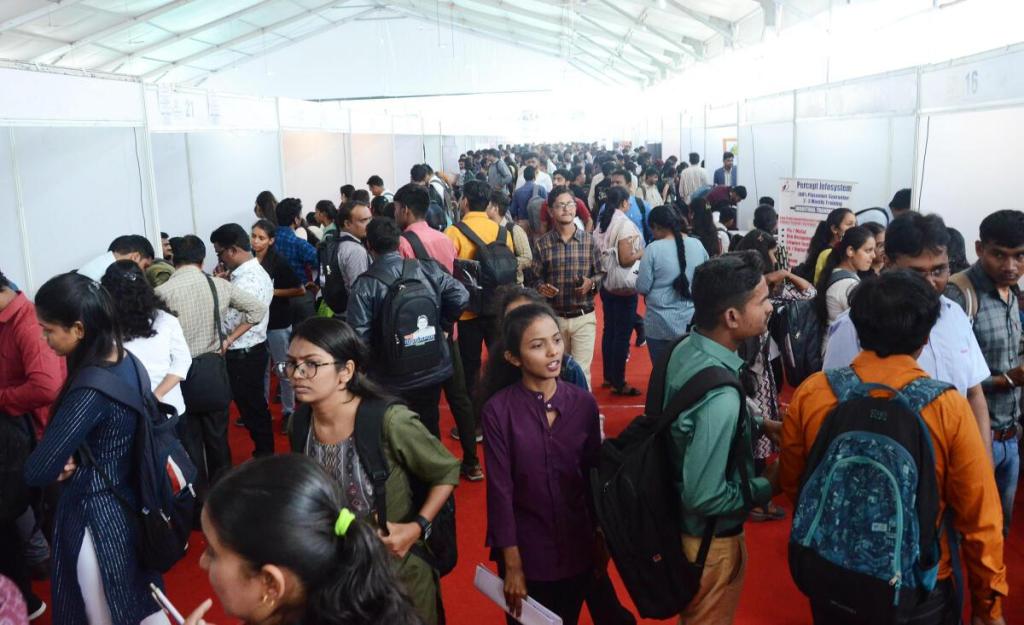
India stands at a decisive moment in the evolution of its higher education system. In 2026, a 23-year old engineering graduate in Pune applies for over 100 jobs. She holds a degree, certifications, and internship experience. Employers tell her she lacks industry readiness. At the same time, a mid-sized manufacturing firm outside Chennai struggles to hire technicians who can operate automated machinery. Both are in a limbo. Over the past two decades, universities have expanded in number, enrollment has surged, and policymakers have articulated ambitious goals for global competitiveness. Yet the labour market has not transformed at the same pace.
The resulting disconnect between degrees and employment is no longer a peripheral concern; it sits at the centre of debates on economic growth, youth aspirations, and institutional reform. With India projected to have over one billion working-age individuals by 2030, the country’s demographic dividend increasingly depends on whether education systems translate learning into employable skills. Expansion has improved access and social mobility, but it has also revealed structural inefficiencies in the transition from classrooms to careers.
More than an access crisis, India faces an alignment crisis.
India’s higher education expansion has been substantial. The system now includes more than a thousand universities and tens of millions of students, and Gross Enrollment Ratios have steadily increased through initiatives such as RUSA (Rashtriya Uchchatar Shiksha Abhiyan) and expanded technical education infrastructure. Yet labour market absorption has lagged behind. The Periodic Labour Force Survey 2025 shows that unemployment among youth aged 15-29 remains structurally higher than the national average, with urban youth unemployment reaching around 17-18 per cent in recent monthly releases. This inversion of the traditional education-employment relationship suggests structural mismatch rather than cyclical downturn. Education no longer guarantees employment. The issue is not a temporary slowdown; it is structural mismatch.
Employability assessments reinforce this concern. The Economic Survey 2023-24, drawing on India Skills Report data, notes that only about 51.25 per cent of Indian graduates are considered employable, underscoring persistent gaps in applied competencies such as digital skills, workplace problem-solving and industry-relevant training.
The Policy Dilemma: Higher Education versus Labour Market Needs
Despite rising educational attainment, only a small share of India’s workforce has received formal vocational training, far below levels seen in advanced economies. The labour market increasingly demands specialised skills in information technology, healthcare, financial services, and advanced manufacturing, yet many academic programmes remain oriented toward theoretical instruction and examination-based assessment.
This mismatch operates at four levels. First, vertical mismatch: graduates work in roles that require lower qualifications. Engineering graduates prepare for clerical exams, while commerce graduates enter delivery or support roles. Education exceeds job requirements. Second, horizontal mismatch: graduates work outside their field of study. Mechanical engineers move into sales; science graduates enter banking. Field-specific training does not translate into sectoral employment. Third, regional mismatch: skill supply is concentrated in certain states and urban clusters, while job growth is uneven. Tier 2 and Tier 3 institutions often lack strong industry linkages, limiting local absorption. Fourth, skill obsolescence: automation and digitisation alter job tasks faster than curricula adapt. Industry demands applied competence, not theoretical familiarity.
Much of this mismatch reflects institutional constraints within India’s higher education governance structure. Curriculum revisions in many universities remain tied to lengthy regulatory approval cycles, slowing the updating of programmes in response to technological and sectoral change. Industry participation in curriculum design also remains limited outside a small group of elite institutions, leaving many programmes insulated from evolving labour market requirements. At the same time, labour market dynamics reinforce the gap: a large share of firms, particularly small and medium enterprises, operate with limited capacity to invest in structured training pipelines.
The result is a coordination problem in which universities produce graduates based on academic frameworks while employers expect applied, work-ready skills.

Image Source: ORF
These dynamics reflect a broader governance fragmentation across education, labour, and industrial policy. Research by ICRIER shows that both overeducation and undereducation coexist: highly qualified graduates accept jobs below their skill level, while employers report difficulty finding candidates with practical competencies. This “bumping down” effect, as noted by Green and Zhu, has broader social consequences, as graduates displace less educated workers while remaining underutilised themselves.
The persistence of mismatch also reflects an incentive problem within the system. Universities are evaluated largely through accreditation metrics such as infrastructure, faculty strength, and enrollment rather than graduate employment outcomes. Faculty promotion systems prioritise research output over industry engagement, while employers frequently prefer experienced hires instead of investing in structured training pipelines. State governments, meanwhile, compete on expanding Gross Enrollment Ratios. As a result, no single institutional actor is directly accountable for employability outcomes.
The paradox extends beyond institutional design into social expectations. Educated youth often prefer formal-sector employment associated with status and stability, even as much of India’s job creation occurs in informal or emerging sectors. The result is congestion in government and service-sector jobs alongside persistent skill shortages in manufacturing and technical occupations.
Sectoral patterns illustrate this mismatch. The IT services sector absorbs high-skill graduates but demands strong applied capabilities. Manufacturing requires technically trained diploma holders and shop-floor technicians, yet many degree programmes remain theory-heavy. Healthcare faces shortages in paramedical and allied health professionals even as general graduates struggle to find work. Emerging sectors such as electric vehicles and renewable energy require hybrid technical skills that remain weakly embedded in many curricula.
Gender disparities compound this dynamic, with urban educated women experiencing significantly higher unemployment rates despite rising educational attainment, reflecting both labour market discrimination and social constraints. At the same time, education increasingly functions as a signal rather than a guarantee of skill. A growing share of graduates enter informal, contract, or platform-based work. Degrees are used by employers as screening devices even when job tasks do not require advanced knowledge. Credential inflation follows. While the wage premium for tertiary education remains positive, returns vary sharply across institutions and fields of study.
Current Reforms in India: Evaluating the NEP 2020
The National Education Policy 2020 represents one of the most ambitious attempts to modernise India’s higher education architecture. Its emphasis on multidisciplinary learning, flexible degree pathways, and vocational integration reflects an acknowledgement that rigid academic models no longer match contemporary labour market realities. The introduction of academic credit banks, multiple exit options, and skill-based curricula aims to reduce the sharp divide between academic and vocational pathways. Embedded within this design is the recognition that employability requires structured exposure to workplace settings, modular skill acquisition, and greater permeability between academic and vocational tracks.
Early implementation trends reveal uneven institutional readiness rather than uniform transformation. Part of the challenge is that NEP 2020 primarily reforms curriculum architecture rather than institutional incentives. While mechanisms such as academic credit banks, internships and multidisciplinary programmes increase flexibility for students, universities still operate under funding and regulatory frameworks largely disconnected from graduate employment outcomes. As an EY analysis on the future of higher education in India notes, while leading institutions are experimenting with interdisciplinary curricula and industry partnerships, many universities continue to face constraints in digital infrastructure, faculty training and resource allocation.
NEP 2020 has foregrounded interdisciplinary curricula and skill integration, yet implementation debates increasingly point to institutional capacity as a central challenge. Small and medium enterprises, which account for a large share of employment generation, often face compliance burdens and limited incentives to participate in structured apprenticeship or internship programmes. As a result, employer engagement remains uneven, limiting the scale at which experiential learning can be institutionalised.
The Confederation of Indian Industry has highlighted the expansion of micro-credentials and short-cycle certifications as an emerging response to skill gaps. EY’s assessment of technology adoption in higher education points to growing interest in modular, stackable learning formats aligned with emerging digital and data-driven industries. These programmes reflect a broader shift toward lifelong learning models, allowing graduates to reskill in response to technological change. Their long-term credibility, however, will depend on integration within national qualification frameworks and consistent employer recognition.
Their credibility will depend on integration into national qualification frameworks and consistent employer recognition. Without this, micro-credentials risk becoming supplementary certificates rather than reliable signals of labour market competence.
Global Lessons
International experience offers useful lessons on how education systems can align more closely with labour market needs. Germany’s dual education system is frequently cited as it embeds industry collaboration directly within the structure of higher education and vocational training. Students alternate between classroom instruction and paid apprenticeships, while employer associations participate in curriculum development. Apprenticeships are recognised within national qualification frameworks, ensuring that practical training carries formal academic value. Regulatory incentives also encourage firms to invest in training, aligning workforce development with industrial strategy. As a result, responsibility for skill formation is shared between firms and the state rather than resting solely on universities.
The relevance of the German model for India lies less in direct replication and more in its institutional philosophy. Structured coordination between employers, universities, and regulators ensures that curricula evolve alongside technological change. Labour market research by the European Commission shows that systems with integrated training pathways tend to experience lower levels of both vertical mismatch, where education levels exceed job requirements, and ‘horizontal mismatch, where graduates work outside their fields of study.
A complementary lesson emerges from South Korea’s development experience. During its period of rapid industrialisation, expansion in tertiary education was closely aligned with national manufacturing priorities. Engineering and technical education capacity grew alongside sectoral strategies in electronics, automotive production, and shipbuilding. Unlike Germany’s employer-led apprenticeship system, South Korea relied more heavily on state-led coordination between education planning and industrial policy. The underlying principle, however, was similar: education supply was calibrated to economic demand rather than expanding independently of it.
India has experimented with apprenticeship schemes and skill development initiatives under programmes such as Skill India and the National Skill Qualification Framework, but implementation remains uneven. Employers often face regulatory complexity, and universities lack consistent incentives to embed workplace learning within degree structures. As noted by NITI Aayog, scaling up apprenticeship systems would require simplified compliance procedures, stronger state–industry collaboration, and recognition of experiential learning within academic credit systems.
Taken together, global experience suggests that reducing education = employment mismatch requires more than curricular reform.
It depends on sustained institutional coordination, predictable incentives for employer participation, and deliberate alignment between education policy and sectoral growth strategies.
What India Has Gotten Right
Despite persistent challenges, India’s reform trajectory has produced meaningful progress. Higher education participation has expanded across socio-economic groups, contributing to the emergence of a large educated workforce. Digital learning platforms introduced during the pandemic accelerated experimentation with blended teaching models and expanded access to specialised training. Policy discourse itself has evolved, with parliamentary debates increasingly linking education reform to employment outcomes, artificial intelligence adoption, and industrial competitiveness.
Periodic Labour Force Survey data and labour-market analyses indicate that individuals with higher education levels continue to record stronger employment outcomes over time, even in contexts marked by mismatch. While unemployment among graduates remains a concern, advanced education continues to correlate with higher employment-to-population ratios and lower rates of informal employment. As emphasised by McKinsey’s research team, this suggests that expansion has not been misplaced but requires stronger alignment with sectoral growth strategies.
Public sentiment has also shifted. The narrative around universities is moving away from viewing them solely as centres of academic prestige toward recognising their role in economic transformation. Policymakers increasingly acknowledge that curriculum flexibility, interdisciplinary learning, and digital skills integration are necessary for navigating a rapidly changing labour market shaped by automation and global competition.
Building on Existing Gains
The next phase of reform is likely to focus on strengthening institutional linkages between education and employment. Institutionalised industry advisory mechanisms could ensure that curricula evolve alongside labour market needs. Structured apprenticeship pathways embedded within degree programmes would reduce the transition gap between education and employment, addressing the experience deficit cited by many employers. National frameworks that recognise micro-credentials alongside traditional qualifications could enable flexible skill validation, while sustained investment in faculty development would support experiential and technology-enabled teaching.
International labour market research suggests that countries with structured employer participation in training systems experience lower mismatch rates. In Germany, for example, roughly half of secondary graduates enter apprenticeship pathways that combine classroom instruction with firm-based training, directly linking education supply with sectoral demand.
Digital transformation will play a central role in this process. Online platforms already enable modular learning pathways that allow students to accumulate industry-relevant skills without abandoning formal degrees. If aligned with labour market demand, these systems could support stackable credentials that respond to shifting sectoral needs. Research on labour market dynamics emphasises that mismatch is not merely a supply problem but a coordination challenge, requiring universities, employers, and policymakers to operate within a shared framework of workforce planning.
Way Forward: Navigating Towards a Skilled Workforce
The coming decade will determine whether India can convert educational expansion into sustainable economic opportunity. Automation, artificial intelligence, and digitalisation are reshaping job requirements across sectors, demanding graduates who can adapt to evolving work environments.
A likely trajectory is the emergence of hybrid education models that combine academic depth with modular, industry-aligned training. Universities may evolve into lifelong learning hubs offering continuous upskilling opportunities rather than one-time credentials. Such a shift would align with global trends toward flexible career pathways and reduce the structural mismatch that currently characterises India’s labour market.
India’s higher education system has laid a substantial foundation through recent reforms, expanding access and introducing policy frameworks that recognise the importance of skills alignment. The challenge now lies in translating these reforms into coordinated institutional practice. Success will depend on the country’s ability to integrate education policy with labour market planning and industrial development. If alignment deepens, the demographic dividend could become a driver of innovation and productivity; if not, the growing pool of educated but underutilised youth risks becoming a long-term structural constraint on economic growth.

 Inflect
Leave a comment