India’s disaster management framework has shifted from a relief-centric approach to one that formally recognises disaster risk reduction (DRR). However, this transition remains uneven in practice. While policies emphasise preparedness and resilience, outcomes continue to reflect persistent vulnerabilities shaped by planning gaps, response-oriented financing, and limited local capacity. Disaster spending remains concentrated on relief and reconstruction, reinforcing cycles of repeated damage rather than reducing risk. Fragmented governance and weak integration of risk into development further constrain implementation. These patterns are reflected in recurring losses across regions, including Himachal Pradesh, which has recorded over 5,000 landslides since 2018, illustrating how risk is not episodic, but accumulates over time through planning decisions and systemic realities.
An Evolving Approach to Disasters
Disasters in India are typically managed through established relief mechanisms, including relief mobilisation, compensation announcements, and efforts to restore essential services. These systems have become more organised and responsive over time, reflecting improvements in administrative coordination and emergency management. However, repeated events across the states have brought forth a limitation: such responses are effective in addressing immediate impacts, but less so in reducing the risks that shape the scale of these losses.
In effect, the system had become more effective at managing consequences, without a corresponding reduction in the conditions that produce them. This has, over time, shifted the framing of disaster management toward disaster risk reduction (DRR), wherein the emphasis lies on anticipating risks, reducing exposure, and strengthening systems before hazards translate into damage. This shift took clearer institutional form with the Disaster Management Act, 2005, which established national and state-level authorities and expanded the scope of disaster governance beyond relief. It formally incorporated prevention, preparedness, and mitigation as core components. India’s alignment with the Sendai Framework for Disaster Risk Reduction in 2015 further reinforced this direction, placing greater emphasis on understanding risk, investing in resilience, and embedding preparedness within development planning.
Expanding Frameworks, Uneven Outcomes
This shift is reflected in the expansion of India’s disaster governance architecture.
The National Disaster Management Plan explicitly integrates DRR across sectors, emphasising risk-informed infrastructure, early warning systems, and coordinated institutional response. Forecasting capabilities, particularly for cyclones, have improved significantly, and climate risk is increasingly acknowledged across sectoral policies. However, observed outcomes indicate that these frameworks have not translated into a commensurate reduction in losses.
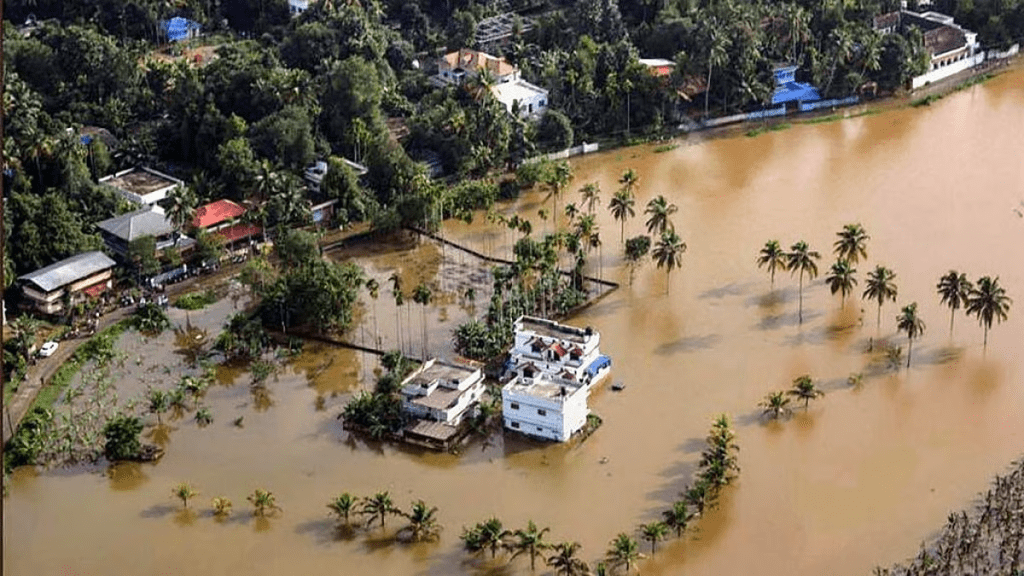
Image Source: Down To Earth
The 2018 Kerala floods caused damages exceeding ₹40,000 crore and affected over 5 million people, with post-disaster assessments highlighting issues in floodplain management, reservoir operations, and unregulated construction. Taken together, these factors suggest that the scale of impact was shaped not only by the hazard, but by underlying land-use, water management, and settlement patterns. In Mumbai, repeated flooding underscores similar gaps. The 2005 Mumbai floods led to over 1,000 deaths and economic losses estimated at around ₹20,000 crore, largely due to inadequate drainage capacity and encroachment on natural waterways. More recently, in July 2021, extreme rainfall once again paralysed the city, disrupting transport networks and exposing the continued limitations of urban drainage upgrades. The persistence of flooding suggests that infrastructure upgrades, in isolation, may prove to be insufficient without parallel adjustments in land-use practices and risk-sensitive planning.
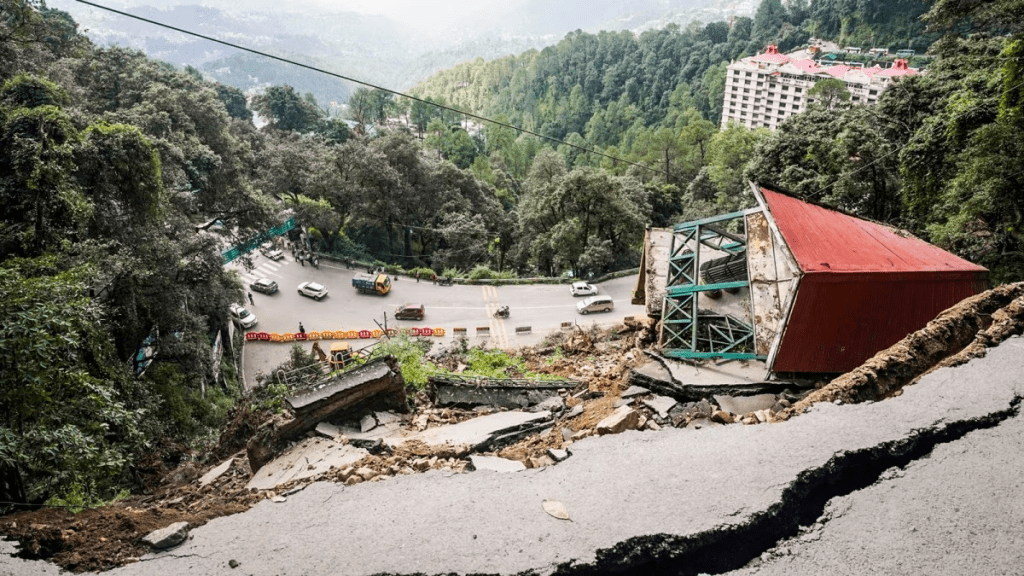
Image Source: The Indian Express
In Himachal Pradesh, the scale and frequency of disasters have intensified. Since 2018, Himachal Pradesh has recorded over 5,000 landslides, nearly 300 flash floods, and more than 140 cloudburst events, with losses of around ₹10,000 crore in 2023 alone. Roads, bridges, and public infrastructure suffered repeated collapse, pointing to construction in high-risk zones and limited integration of ecological risk into infrastructure planning. These trends indicate that losses are increasingly shaped by cumulative exposure in ecologically sensitive terrain, rather than by isolated extreme events.
Across these realities, a consistent pattern is visible; that while the capacity to respond to disasters has improved, the processes that generate and amplify risk remain insufficiently addressed. The result is not a failure of response systems, but a limitation in how far risk reduction has been embedded into everyday planning and development.
Resource Allocation and the Response Bias
This limitation is reflected in the structure of disaster financing. India’s disaster financing architecture, anchored in the National and State Disaster Response Funds (NDRF and SDRF), is primarily designed for post-disaster expenditure. Expenditure is largely triggered after events occur and is directed toward relief, compensation, and immediate restoration. There is comparatively limited emphasis on risk reduction, despite the presence of mitigation funds.
Relief expenditure typically includes ex gratia payments to affected households (for loss of life, injury, livestock, or housing), provision of food, water, and temporary shelter, and short-term livelihood support. Compensation norms are standardised, for instance, fixed payouts for loss of life or partial and full housing damage, leading to a system that prioritises immediate disbursement over long-term resilience. Reconstruction similarly prioritises restoring infrastructure, such as public roads, bridges, and public assets within short timeframes, often without systematically incorporating risk- resilient design.
This structure produces two observable effects. First, it creates a cycle where public finance is repeatedly deployed to repair the same categories of damage. For example, in states such as Himachal Pradesh, successive monsoon seasons have required large allocations for road and bridge reconstruction following landslides and flash floods. Second, it limits fiscal space and administrative attention for investments that could reduce these losses in the first place- such as slope stabilisation, drainage planning, or resilient housing. In essence, the financing architecture links expenditure closely to realised damage, while providing fewer incentives and resources for underlying risk over time.
This pattern extends to how resilience is operationalised. While resilient infrastructure implies designing assets to withstand future climate and hazard risks. Resilient infrastructure, in principle, involves designing assets- such as drainage systems, roads, and housing- to withstand future climate and hazard risks. In practice, however, infrastructure restoration often prioritises speed and cost over long-term risk considerations. As a result, rebuilt assets remain exposed to similar risks, contributing to repeated damage.
At the implementation level, this financing structure shapes institutional behaviour. Early warning systems have improved, but their effectiveness depends on whether systems exist to act on them. Where evacuation infrastructure, last-mile communication, and local coordination mechanisms are weak, warnings do not translate into timely action. This points to a misalignment between resources allocation and the systems required to translate risk information into action.
Capacity, Coordination, and Incentives
The constraints in risk reduction are most visible at the implementation stage. While national frameworks emphasise preparedness and risk reduction, their effectiveness depends on local institutions, including district administrations, municipalities, and frontline agencies, tasked with translating these priorities into action. This is where capacity constraints begin to shape outcomes.
Disaster risk reduction is inherently local.
It requires granular risk mapping, enforcement of land-use and building regulations, maintenance of drainage and protective infrastructure, and community-level preparedness. However, local bodies often operate with limited technical expertise and fragmented data systems. For instance, urban local bodies in cities like Mumbai have undertaken drainage upgrades, yet flood vulnerability persists. This points to challenges in integrating rainfall data, land-use changes, and encroachment mapping. Similarly, in hill states such as Himachal Pradesh, infrastructure planning frequently proceeds without detailed slope stability assessments or cumulative risk analysis, contributing to repeated landslides and infrastructure loss.
Institutional fragmentation further constrains implementation. Responsibilities for disaster risk reduction are distributed across multiple departments, ranging from urban development, water resources, to public works, and environment, each operating with its own planning processes and priorities. Coordination mechanisms tend to activate during crises rather than shape routine decision-making. As a result, risk considerations enter too late, often after projects are designed or implemented. Over time, this can contribute to development patterns that increase exposure, including construction in floodplains, expansion into ecologically fragile zones, and infrastructure that is not designed for future climate variability.
At the same time, institutional incentives reinforce this pattern. Disaster response, in terms of relief distribution, compensation, and reconstruction, is highly visible and time-bound. It provides clear evidence of action and is supported by established financial flows. In contrast, the outcomes of disaster risk reduction are less tangible. When drainage systems prevent flooding or evacuation plans reduce losses, these successes are not easily observed or measured.
The interaction of capacity constraints, fragmented governance, and incentive structures results in a cumulative effect: risks are not addressed during planning, further accumulating vulnerabilities, resulting in reactive responses to disaster events. Over time, this produces a form of ‘institutional inertia’, where the same categories of damage recur, and lessons from past events remain only partially embedded in future decision-making.
Toward Anticipatory Governance
These patterns indicate a gap between policy intent and operational practice. While policy frameworks emphasise preparedness and risk reduction, in practice, expenditure, institutional arrangements, and planning processes continue to be more closely aligned with response.
Addressing this imbalance would require adjustments within existing institutional and financing structures, particularly in how resources are structured and linked to outcomes, rather than only an increase in allocations. One observable direction has been the gradual move toward greater involvement of local governments in planning and implementation, given that risk is most clearly understood and managed at the local level. However, the effectiveness of this approach depends on whether devolution is accompanied by adequate financial resources, technical capacity, and clarity in roles. In practice, the ability of local institutions to undertake these functions varies across states, reflecting differences in fiscal capacity, administrative support, and institutional continuity. Strengthening these capacities- through more predictable financing, technical support, and clearer functional responsibilities- would be critical to enabling local-level risk reduction.
A second constraint lies in how performance is defined and tracked. Existing systems tend to capture post-disaster outputs, but offer limited insight into changes in vulnerability or preparedness. As a result, it remains difficult to assess whether risk is being reduced over time, beyond immediate post-disaster outputs. Embedding indicators such as exposure reduction, system readiness, and avoided losses within central and state monitoring frameworks would enable a more complete assessment of outcomes and help align incentives toward risk reduction.
The integration of disaster risk into routine planning processes also remains inconsistent. In sectors such as infrastructure and urban development, risk assessments are not uniformly embedded at the design stage, which limits their influence on project decisions. Systematically integrating risk assessments at the project design stage- particularly within infrastructure approvals, urban planning processes, and sectoral investments- would enable risk considerations to shape both the design and location of assets, rather than being incorporated retrospectively.
As the UN Office for Disaster Risk Reduction emphasises, sustained reductions in disaster losses are closely linked to investments in risk reduction and preparedness. In the Indian context, while exposure to natural hazards remains significant, the manner in which risk considerations are reflected in planning, financing, and implementation will define how India responds to climate risks in the coming decades.

 Inflect
Leave a comment