In April 2026, Indian parliament found itself embroiled in a furore over women’s political representation. The government introduced three interconnected bills: the Constitution (131st Amendment) Bill, the Delimitation Bill, and the Union Territories Laws (Amendment) Bill, seeking to operationalise the landmark women’s reservation that had been settled in 2023. The move reignited fierce debate, not because the principle of reserving seats for women was contested, but because of what came bundled with it- a sweeping delimitation exercise that would redraw parliamentary constituencies using the 2011 census, potentially expanding the Lok Sabha to 800+ seats and altering the balance of political power between northern and southern states. Critics immediately saw through the packaging. Rather than a clean act of women’s empowerment, the bills appeared to many as a constitutional ruse- using the promise of gender justice to push through a demographic redistribution. Opposition parties, particularly from the south, accused the Centre of weaponising women’s reservation as a Trojan horse for parliamentary expansion, calling the 131st Amendment Bill anti-federal and constitutionally dubious. At the core of this controversy lies a clear tension. There is unanimous agreement across parties on the need to improve women’s representation in legislatures, yet there is deep disagreement on the timing, sequencing, and design of the reform.
About the Nari Shakti Vandan Adhiniyam
The current legal foundation for women’s political reservation in India is the Constitution (106th Amendment) Act, 2023, also known as the Nari Shakti Vandan Adhiniyam.In September 2023, Parliament demonstrated rare political consensus when the Lok Sabha passed the bill with an overwhelming 454 votes in favour during the first session in the new Parliament building. The amendment marked a significant milestone by providing for the reservation of one third of all seats in the Lok Sabha and state legislative assemblies for women, along with a sub quota for women within seats already reserved for Scheduled Castes and Scheduled Tribes. After nearly three decades of unsuccessful attempts through bills introduced in 1996, 1998, 1999, and 2008, India appeared to have finally established a constitutional framework for gender parity in legislative representation.
The catch, however, was buried in the implementation clause. The reservation will come into effect only after the completion of a fresh Census followed by a delimitation exercise. Delimitation refers to the process of redrawing the boundaries of parliamentary and assembly constituencies to reflect changes in population, ensuring that each constituency has roughly equal representation. The 2021 Census was postponed due to COVID-19, and the government indicated in 2025 that the next Census would begin in 2027, with March 1 as the reference date. Delimitation commissions historically take years to complete their work after census data becomes available- the last one, constituted in 2002, finalised its orders only in 2008. Even under an optimistic timeline, this sequence is likely to delay the introduction of women’s reservation until after the 2029 general elections, and possibly into the mid 2030s. The law also provides that reservation will operate for 15 years, with seats rotating across constituencies. This is not a minor procedural detail. In effect, it means that a reform widely described as historic may not translate into any immediate change, with its impact deferred for at least a decade.
Historical Trajectory of Women’s Representation in India
India’s journey toward women’s political empowerment reflects a clear disconnect between early institutional promise and actual legislative outcomes. The country granted equal voting rights to women at independence, placing it among the first democracies to do so and establishing a constitutional framework that formally supported gender inclusive participation. However, this commitment has not translated into proportional representation in elected bodies. In the 18th Lok Sabha, formed after the 2024 general elections, only 74 women were elected, accounting for 13.6% of the 543 seats. This marks a decline from 2019, when 78 women were elected, representing 14.4%. According to the Inter Parliamentary Union’s global rankings, which track 185 countries, India stands at 148th position. India therefore trails not only most Western democracies but also several neighbouring countries such as Nepal (50th) and Pakistan (111th).
The historical trajectory is equally sobering. From the 1950s through to 2004, women’s share of Lok Sabha seats hovered between 5% and 10% and rose only marginally to 12% in 2014. The current 13.6% remains well below the IPU’s global average of 27.5% as of April 2026. By comparison, Rwanda, which has consistently topped global rankings, saw its lower chamber reach 63.8% women following the 2024 elections, supported by legislated gender quotas. Other countries with strong quota systems or voluntary party parity commitments have also moved ahead of India. The United Kingdom crossed 40% women in the House of Commons for the first time after 2024, while the United States stands at around 28.7%. At the state level, the gap is even more pronounced. Women account for only about 9% of members in legislative assemblies, and no state has crossed the 20% mark. The contrast with local governance is striking. The 73rd Constitutional Amendment Act and 74th Constitutional Amendment Act mandated one third reservation for women in Panchayati Raj institutions and urban local bodies. Over time, many states increased this to 50%. As a result, nearly 46% of elected representatives in gram panchayats are women, making India a global outlier in local level gender representation even as higher legislatures remain overwhelmingly male.
Rationale for Women’s Reservation
The arguments in favour of the bill are compelling and grounded in both normative and empirical reasoning. At the most basic level, the case rests on democratic legitimacy. Women constitute nearly half of India’s population but occupy only about 14% of seats in Parliament. This is not merely an abstract inequality; it means that the legislative branch of government systematically under-represents the interests, experiences, and perspectives of half its citizens. The bill is also justified as a measure of corrective justice. Historical exclusion, reinforced by social norms and institutional barriers, has limited women’s entry into politics. Reservation offers a structural intervention to address these entrenched inequalities and ensure a more equitable distribution of political voice. Evidence from local governance strengthens this argument.
Experiences under Panchayati Raj institutions show that women’s reservation in local governance increased investment in public infrastructure needed by women, with measurable improvements in sanitation, drinking water, health, and education outcomes in reserved panchayats, indicating that greater representation at higher levels could meaningfully shape policy outcomes. Another important argument is that reservation can act as a pipeline mechanism, enabling more women to enter politics, build experience, and eventually compete without quotas. This links to the broader claim that descriptive representation can translate into substantive representation, increasing attention to issues such as health, safety, and labour force participation .Finally, the persistence of low representation exposes the limits of voluntary approaches. Political parties have repeatedly pledged to field more women candidates, but the numbers have changed only marginally. In the 2024 Lok Sabha elections, the Bharatiya Janata Party, which fielded the highest share among major national parties, nominated women in only 15.5% of its 446 seats, while the Indian National Congress fielded women in 13.7% of its 328 seats. Across all 8,360 candidates, only 799 were women, accounting for 9.6%, and 152 out of 543 constituencies had no women candidates at all. After more than seven decades of representative democracy and repeated commitments to reform, the expectation that political parties will independently address this imbalance lacks credibility. In this context, legislative intervention appears not simply desirable but necessary.
Key Critiques
However, the bill raises a set of substantive concerns that go beyond questions of political intent and speak directly to its design and likely impact. The most immediate issue is the delay in implementation. This dilutes the immediacy of what is otherwise presented as a transformative reform and weakens the urgency of advancing gender parity in legislatures. A second concern relates to the absence of sub-quotas for OBC and minority women. In its current form, the bill treats women as a homogeneous category, overlooking entrenched social hierarchies that shape access to political power. Without internal reservation, there is a credible risk that the benefits will accrue disproportionately to relatively privileged groups, limiting the redistributive potential of the policy and raising questions about its inclusiveness.
The design of seat rotation presents a third challenge. While rotation is intended to ensure that reservation is not confined to specific constituencies, it introduces instability into the electoral system. Representatives may have limited incentives to invest in long term constituency development if their seats are de-reserved after a single term. This weakens accountability and disrupts the accumulation of political experience, both of which are central to effective representation. Evidence from Panchayati Raj institutions suggests that frequent rotation can, at least initially, encourage forms of proxy representation, where elected women are influenced by male family members. Although such patterns tend to decline as women gain political experience, the structure of the system may still constrain the development of independent leadership.
The most politically charged critique concerns the linkage with delimitation. Redrawing constituency boundaries based on population changes has far reaching implications for the distribution of political power. Proposed reforms could expand the Lok Sabha to over 800 seats and alter its regional composition. States in the south, which have experienced lower population growth, fear a reduction in their relative representation compared to northern states. By tying women’s reservation to this process, the reform becomes embedded within a broader contest over federal balance. As a result, a measure that might otherwise have commanded broad consensus is recast as part of a more contentious restructuring of India’s electoral landscape, complicating both its reception and its eventual implementation.
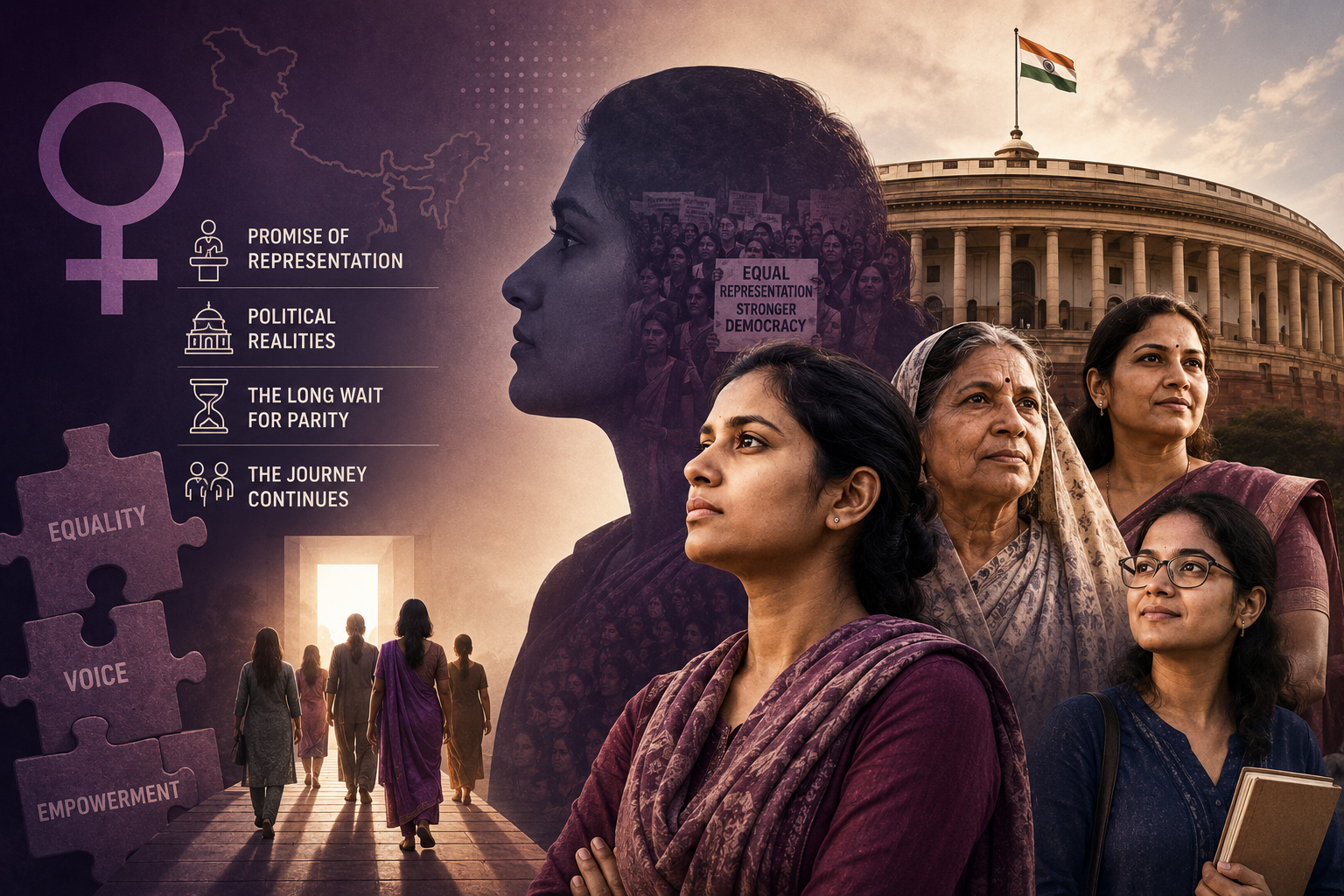
The Women’s Reservation Bill represents one of the most consequential yet incomplete reforms in India’s democratic trajectory. First introduced in 1996, it has been shaped by decades of political negotiation, competing priorities, and institutional constraints. The Constitution (106th Amendment) Act, 2023 marked a decisive step forward by formally embedding the principle of gender-based reservation within the constitutional framework, signalling broad political acceptance of the need to enhance women’s representation. At the same time, the structure of the law underscores a persistent challenge in policy design and implementation. By making the rollout of reservation contingent on the completion of a Census and a subsequent delimitation exercise, the reform introduces a significant time lag between enactment and impact. This creates a gap between intent and outcome, where a measure widely regarded as transformative does not immediately translate into greater representation in legislatures. As India now navigates the complex terrain of delimitation, the women who were supposed to be the beneficiaries of this legislation find themselves, once again, waiting— their representation a bargaining chip in a larger contest of power.

Leave a Reply