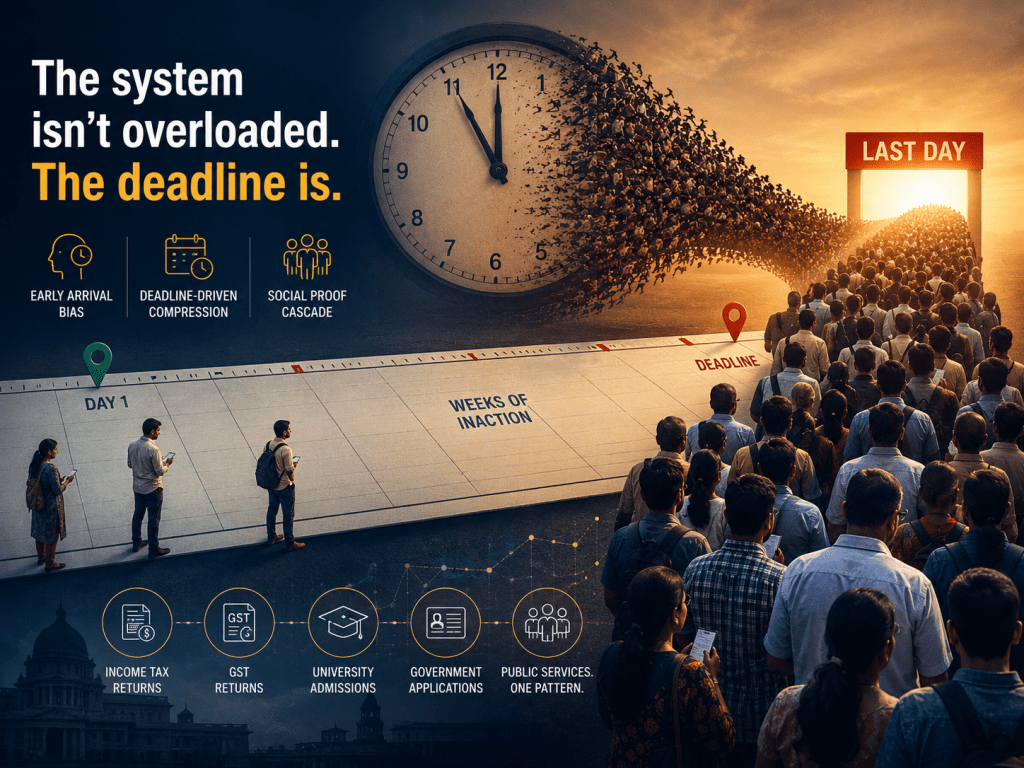
Every year the Income Tax Department of India processes a mammoth number of returns on the final day of filing, despite the window staying open for months. The GST portal reportedly crashed on its deadline in August 2023, January 2025, and April 2026, with over 50 lakh active filers converging on the same 24-hour window.
These breakdowns are not merely technical, but behavioural, and embedded within systems that were not built to reflect how individuals actually perceive and use time.
Why Timing Gets Bunched Together
Users rarely distribute their actions evenly across the time available to them. Instead, they gravitate toward specific moments that feel safer, more urgent, or socially validated. This clustering effect is driven by three core behavioural dynamics.
The first is early arrival bias, a product of loss aversion and uncertainty discounting. At the beginning of any time window, when access to a service feels uncertain or queue-dependent, individuals often systematically overestimate the cost of missing out relative to the cost of acting early. This is visible in university admission portals and scholarship application systems, where submissions spike sharply on the first day despite deadlines being weeks away and no advantage to early submission. Acting early feels like the only reliable strategy, even when the system does not reward it.
The second is deadline-driven compression. If early in the cycle, behaviour is shaped by perceived risk, the middle is defined by inaction. As long as a deadline sits weeks away, it carries little urgency. The mental cost of acting feels larger than the cost of waiting, so action is deferred. When the deadline becomes immediate, that calculation flips sharply, and activity concentrates in a narrow window. This reflects hyperbolic discounting at scale, and explains why the final day of any government filing cycle looks nothing like any other day in the calendar.
The third is social proof cascading. As this late-stage surge begins, individual hesitation is replaced by collective momentum. Accountants get booked out in the last week, and news alerts say “last date today,” while government advisories intensify. All of this signals that now is when others are acting, reinforcing the same decision for anyone still waiting and compressing demand further into the same moment.
What this pattern makes clear is that the surge is not accidental, but is produced by design. This leads directly to a common but misplaced response: trying to fix the peak by expanding capacity.
Why Capacity Expansions Miss the Core Problem
More servers, additional counters, and extended hours address throughput at the peak, not the incentive that creates the peak. A portal engineered to handle 10 lakh simultaneous users on the 20th of the month will still face a 20th-of-the-month surge if every user faces an identical deadline with no reason to act before it.
At the same time, this does not negate the role of traditional market forces. In contexts where demand genuinely exceeds supply or infrastructure is constrained, capacity expansion and pricing mechanisms remain necessary. The behavioural patterns therefore operate most strongly where capacity exists across time but is unevenly utilized. Distinguishing between structural scarcity and behavioural clustering is therefore critical to choosing the right intervention.
Effective Approaches to Demand Redistribution
Shifting demand requires changing what earlier action feels like, not mandating it.
India’s CBDT NUDGE campaign, which dispatches SMS and email advisories weeks ahead of the December 31 revised-return deadline, produced a measurable shift in the 2025–26 assessment cycle, with more than 21 lakh taxpayers filing revised returns before the final deadline window, reducing last-day processing load without any enforcement. The nudge carried no financial incentive; the salience of an early, personalised prompt was sufficient.
This makes clear that the impact of these interventions is not accidental, and stems from shifting the underlying cues that guide behaviour. To sustain this shift, the focus has to move to where those cues originate within the system.
Where the Lever Sits
Individuals often do not carefully optimise their timing. Instead, they respond to cues, effort levels, and perceived risk. This aligns with findings from bounded rationality, where decisions are shaped by heuristics rather than deliberate optimisation.
As of now, the design of most public service systems quietly rewards waiting: more information becomes available later, reminders intensify near the deadline, and social signals peak at the end. Making earlier action marginally easier, more visible, or marginally more rewarding is enough to begin spreading demand. The goal is not eliminating the last-day rush; it is reducing how many individuals feel structurally compelled to be part of it.

 Inflect
Leave a comment