Few institutional innovations in Indian development policy have achieved the reach, durability, and cross-scheme ubiquity of the Self-Help Group (SHG). From a quiet pilot in Karnataka in the mid-1980s to a network of over twelve million groups encompassing approximately 140 million women, the SHG today constitutes the primary capillary through which the Indian state delivers credit, welfare, livelihood, and social-protection programmes to its poorest citizens. It is simultaneously a financial instrument, a governance unit, and in the state’s preferred framing- a vehicle of women’s empowerment. This article offers a design-level analysis of the SHG model, focusing on how its institutional architecture operates in practice, with particular attention to the ways in which credit, discipline, and administrative responsibilities are organised, and how the associated costs and risks are distributed across those who participate in it.
Origins and Institutional Genesis
The intellectual foundations of the SHG model in India draw from two closely aligned but distinct trajectories. The first originates in the work of Grameen Bank, where Muhammad Yunus demonstrated in the late 1970s and early 1980s that group-based, collateral-free lending to poor women could sustain high repayment rates by relying on social collateral in the form of peer monitoring and collective accountability. Running in parallel, though less widely cited, was the work of Myrada in southern India, which during the mid-1980s organised credit management groups based on the recognition that informal savings and lending practices among rural women already functioned as viable financial systems that could be formalised and linked to institutional credit.
These strands converged in 1992 when National Bank for Agriculture and Rural Development (NABARD) launched the Self-Help Group Bank Linkage Programme, which formalised a simple but scalable design: groups of 10 to 20 women would pool savings, undertake internal lending, and build a record of financial discipline before accessing bank credit collectively, thereby lowering transaction costs for banks, expanding access to formal finance for women, and creating a decentralised platform for policy delivery.
By the early 2000s, the model had evolved beyond a microfinance innovation into a central organising principle of rural development, most notably in undivided Andhra Pradesh through the Velugu programme and its successor, the Society for Elimination of Rural Poverty, where SHGs were federated into tiered institutional structures such as village organisations, mandal samakhyas, and district federations that functioned as intermediaries between communities and the state. This federated architecture was subsequently scaled at the national level through the National Rural Livelihoods Mission (NRLM) launched in 2011, later restructured in 2015 as the Deendayal Antyodaya Yojana National Rural Livelihoods Mission, consolidating the role of SHGs as a primary institutional interface for advancing financial inclusion, livelihood promotion, and welfare delivery among rural women.
Current Relevance and Policy Embedding
As of 2023-24, outstanding bank credit to SHGs has reached approximately ₹1.5 lakh crore, marking the highest level since the programme’s inception and signalling a significant deepening of its financial footprint. The average loan size per SHG has risen to around ₹4.3 lakh, indicating greater integration of these groups into formal credit systems. Women constitute nearly 90 per cent of total SHG membership, underscoring the model’s gendered orientation, while its geographic spread now extends across all twenty-eight states, with particularly high levels of penetration in Andhra Pradesh, Telangana, Tamil Nadu, Odisha, and West Bengal.
The SHG infrastructure has evolved into a central pillar of last-mile governance, serving as a key delivery mechanism for a wide range of flagship welfare programmes and development initiatives. Under the National Rural Livelihoods Mission (DAY-NRLM), SHGs constitute the foundational institutional unit for livelihood promotion, social mobilisation, and the convergence of entitlements, with a stated objective of mobilising close to 90 million rural households. Beyond NRLM, their role has expanded into sectoral schemes such as the Pradhan Mantri Awas Yojana (Gramin), where SHG networks in several states are engaged in facilitating beneficiary identification, application processes, and monitoring implementation. Policy initiatives such as the Lakhpati Didi programme, announced in the 2023–24 Union Budget, further reinforce this institutional reliance by targeting two crore SHG women to achieve annual household incomes above ₹1 lakh through structured interventions in skilling, enterprise development, and market integration.

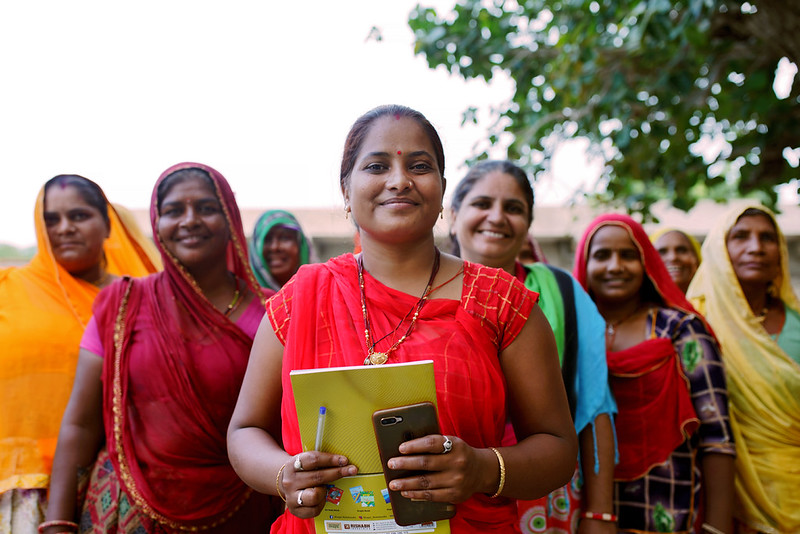
Image Source: Pradan
The adaptability and reach of SHGs were particularly evident during the COVID-19 pandemic, when these networks were mobilised for PPE production, community-level health surveillance, and last-mile ration distribution, underscoring the state’s operational reliance on them in times of crisis. In effect, the SHG has moved well beyond its origins as a microfinance mechanism and now operates, in functional terms, as a primary administrative interface through which the Indian state structures welfare delivery, implements development programmes, and engages with rural women across multiple policy domains.
Critical Assessment
Feminisation of burden:
The SHG is, both by design and in practice, an overwhelmingly female institution, and this gendered orientation is foundational rather than incidental to its policy logic. Its architects, including state planners, development economists, and international financial institutions, grounded the model in a well-documented empirical observation that women tend to exhibit higher rates of savings discipline and loan repayment than men, and that their dense social ties within communities make mechanisms of group accountability more effective and enforceable. However, what remains insufficiently examined is the structural basis of this ‘social embeddedness.’
It is not simply a neutral attribute, but a product of gendered constraints that limit women’s mobility, economic participation, and presence in public spaces within patriarchal settings. In this sense, the SHG model leverages a form of social capital that is itself generated by inequality, without necessarily challenging or transforming the conditions that produce it. The asymmetry becomes clearer when viewed alongside the absence of comparable collective mechanisms for men. Male borrowers are not required to organise into solidarity-based savings groups to access agricultural credit, enterprise finance, or MSME support; instead, they engage with formal financial systems as individuals. This divergence suggests that gender selectivity in programme design functions less as a straightforward instrument of empowerment and more as a means of transferring the burden of ensuring financial discipline and reducing transaction costs onto a population whose economic alternatives remain structurally constrained.
Shame as financial collateral:
The group liability mechanism, the feature that makes SHGs creditworthy to formal banks, operates through peer pressure and the risk of community shame. Repayment enforcement does not rely on legal processes but on the possibility of social exclusion within a woman’s immediate support network. When a member defaults, the group absorbs both the financial burden and the social consequences. For banks, this arrangement is efficient. For the poorest member, who typically has the most fragile livelihood and the least capacity to repay, it can be deeply coercive. She does not face an impersonal legal penalty but the potential breakdown of her closest social relationships. What is often framed as solidarity can, in practice, function as a form of social control tied to financial discipline. This is not a peripheral flaw that can be easily corrected. It is central to how the SHG model sustains high repayment rates and maintains its credibility within formal financial systems.
Credit-poverty trap:
Average SHG loan sizes, typically ranging between ₹25,000 and ₹50,000, remain too small to support meaningful asset creation or the kind of enterprise investment required for a sustained exit from poverty. In practice, a substantial share of this credit is used for consumption smoothing, including meeting urgent needs such as healthcare expenses, education costs, or social obligations like marriages, rather than being deployed for income-generating activities. Repayment is often managed through casual or low-paid wage labour, creating a cycle in which borrowers service existing loans only to take on new ones in response to subsequent financial shocks. While the SHG model has been effective in extending the reach of formal credit to populations previously excluded from banking systems, it does not, in itself, address the structural constraints that limit income growth, such as limited access to stable employment, markets, and productive assets.
Unpaid administrative labour:
As the state increasingly channels a widening range of welfare and development schemes through SHG networks, these groups are gradually repositioned from voluntary collectives to functional extensions of the administrative apparatus. In practice, SHG leaders, often the most literate and organisationally capable women within the group, assume responsibilities that include maintaining official records, attending block-level review meetings, compiling and verifying beneficiary data, and facilitating coordination across multiple departments. While this work is central to the effective implementation of programmes, it is neither formally recognised nor remunerated within any structured employment framework. Instead, it is routinely framed in policy discourse as participation or empowerment, which obscures the extent to which it represents a transfer of administrative responsibilities onto women without corresponding compensation, institutional safeguards, or acknowledgement of their labour.
Case Study: Society for Elimination of Rural Poverty (SERP), Andhra Pradesh

Image Source: SERP
SERP is often seen as the gold standard of India’s SHG movement. Its vast network of women’s collectives later became the institutional template for the NRLM, and on paper, the programme achieved remarkable success. Andhra Pradesh accounts for one of the largest SHG-bank linkage ecosystems in the country, with outstanding SHG loans reaching ₹55,897 crore by November 2022. Nationally, SHG repayment rates stood at 97.7 percent, while Andhra Pradesh’s SHG system has repeatedly reported recovery rates above 99 percent. The scale of mobilisation is equally striking: over 90 lakh women in Andhra Pradesh were linked to SHG-bank credit networks, and cumulative SHG lending in the state increased from just ₹56.6 crore in 1999-2000 to nearly ₹39,392 crore by 2021-22.
Yet the very mechanisms underpinning this ‘success’ also reveal the structural burdens embedded within the model.
Much of SERP’s success depended on intensive peer monitoring and collective liability structures. A World Bank-linked case study on Andhra Pradesh SHGs notes that group-based accountability and federation oversight became central to maintaining repayment performance. For banks, this significantly reduced transaction and recovery costs. For borrowers, however, repayment enforcement often became socially embedded rather than institutionally mediated. There is also evidence that increased access to credit did not consistently translate into long-term livelihood transformation. A NIRD study on SHG credit utilisation found that a substantial share of SHG borrowing in Andhra Pradesh was directed towards consumption smoothing and emergency expenditure, including healthcare, food consumption, education, marriages, and repayment of earlier debt, rather than productive investment or enterprise creation. Similarly, a Dvara Research analysis of SHG-bank linkage in Andhra Pradesh observed that borrowing patterns often spiked during periods of seasonal financial stress, suggesting that SHG credit frequently functioned as a coping mechanism for recurring household vulnerabilities rather than as capital for sustained economic mobility.
The programme’s administrative architecture also depended extensively on women’s invisible and largely uncompensated labour. SHG leaders and federation members were not merely participants in savings groups; they became the operational backbone of welfare delivery at the village level. Their responsibilities routinely included maintaining financial records, identifying beneficiaries, coordinating with banks and local officials, attending review meetings and training, and facilitating the implementation of multiple government schemes. The World Bank-linked study on Andhra Pradesh SHGs documents how federated women’s collectives evolved into key intermediaries between the state and rural households. While this significantly reduced administrative and transaction costs for the state and strengthened last-mile governance capacity, the work itself remained largely informal, inadequately compensated, and framed as voluntary ‘community participation’ rather than recognised as essential administrative labour.
What makes the Andhra Pradesh case particularly significant is that it represents one of the strongest and most institutionally supported SHG ecosystems in India. If concerns around debt-led coping, peer-enforced repayment, and unpaid implementation work remain visible even within a comparatively successful model like SERP, they point to deeper structural issues within the SHG framework itself. Rather than eliminating institutional gaps, the model often redistributed the burdens of welfare delivery, financial discipline, and administrative implementation onto poor women’s collective labour and social networks.
Rethinking the Design
Reforming the SHG model requires a shift in how risk, labour, and responsibility are distributed between the state, financial institutions, and women participants.
First, the current reliance on group liability as a substitute for collateral should be replaced, at least for the poorest borrowers, with publicly backed credit guarantee mechanisms that allow individual women to access loans without being subject to peer-enforced repayment. This would reduce the dependence on social pressure as a tool of financial discipline while retaining access to formal credit. Second, the administrative functions now routinely performed by SHG leaders, such as maintaining official registers, verifying beneficiaries, and coordinating with line departments, should be formally recognised as work with fixed honoraria and clearly defined limits on time commitments, rather than being absorbed as unpaid ‘community participation’.
Additionally, the economic design of SHG lending needs to move beyond small, consumption-oriented loans by creating structured pathways into higher-value activities through aggregation and scale, including support for producer collectives, cluster-based enterprises, and market-linked value chains where women can build assets and generate sustained income. Also, the state must directly address the drivers of recurring debt by strengthening public provisioning in areas such as health, childcare, and basic services, so that households are not compelled to rely on repeated borrowing to manage routine shocks.
Finally, programme design should explicitly redistribute implementation responsibilities by involving men in group-based or parallel institutional structures in sectors where they dominate, thereby preventing the continued concentration of both financial discipline and administrative labour within women’s networks alone.
The Self-Help Group represents one of the most consequential institutional innovations in India’s post-liberalisation development trajectory, with its scale, reach, and organisational durability reflecting a significant policy achievement. The critique advanced here does not diminish these gains; rather, it highlights a structural distortion that has emerged over three decades of expanding state reliance on SHG networks. The model functions effectively in part because it draws upon the social vulnerability of poor women, including their embeddedness in community networks, their exposure to social sanctions, and their limited economic alternatives, as a substitute for robust financial systems and public service delivery that remain underdeveloped. In doing so, it shifts the burden of enforcement, risk management, and programme implementation onto those least equipped to bear it. A more equitable policy framework would require the state to assume direct responsibility for these functions by ensuring access to credit without reliance on coercive social mechanisms, providing essential services without transferring costs onto households, and formally recognising, rather than informally absorbing, the labour that sustains programme delivery.
As currently structured, the SHG model risks positioning women as buffers for institutional gaps, while attributing developmental success to their capacity for resilience rather than to the adequacy of state provision.

Leave a Reply